Bigfoot
Bigfoot Composite Outrigger Pads
Composite outrigger pads that spread the load under bucket trucks and cranes.
Typical $199
 Bucket Truck Accessories
Representative photo. Check the retailer listing for the exact model, color and size.
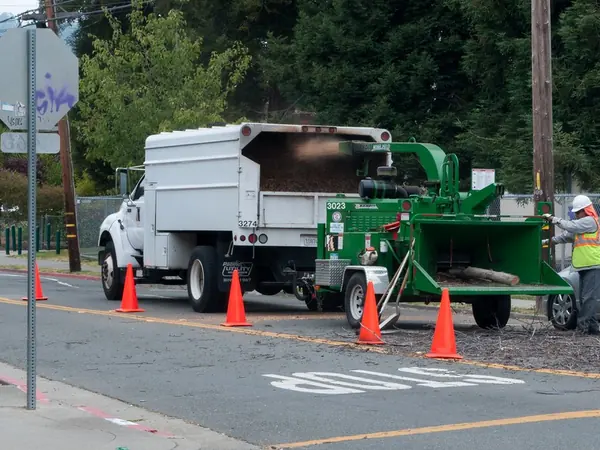
Photo: Traffic Cone by pdugmore2001, CC BY 2.0
A heavy-duty wheel chock for tree trucks, chippers and trailers.
Every crew should chock the wheels of a truck before anyone gets out of the cab to work. A wheel chock is cheap, simple and one of the most important safety items on a tree service truck, especially on bucket trucks, chip trucks and any vehicle parked on a grade.
Parking brakes fail, transmissions get bumped out of park, and ground shifts under a loaded truck. A bucket truck that rolls while someone is in the bucket, or a chip truck that rolls into the chipper crew, is a catastrophic accident that a pair of chocks prevents. That is why most companies and many standards require chocks on any vehicle that is parked for work.
Wheel chocks also tell everyone on site that the truck is set up and not moving. Make placing them part of your arrival routine, along with cones, signs and setting up the work zone.
Tree trucks are often parked on residential streets with a crown, on driveways with a slope, or on soft shoulders. Each of those increases the chance of a vehicle creeping, especially once the chipper is running and the truck is vibrating.
Chocks matter for chippers too. A towed chipper parked on a slope with the truck unhooked has nothing holding it but its own jack, and a rolling chipper is as dangerous as a rolling truck.
Set the parking brake first. Then place the chocks snug against the tires on the downhill side, so gravity pushes the tire into the chock. On level ground, chock both front and back of one tire. On a slope, chock the downhill side of both rear tires, or follow your company and vehicle maker's procedures if they call for more.
For bucket trucks, chock before you set the outriggers and do not pull the chocks until the boom is stowed and the outriggers are up. On a trailer or chipper, chock the trailer wheels before unhitching. Always remove the chocks before you drive off. A lot of crews hang a tag on the steering wheel as a reminder.
Train everyone on the crew to do it, not just the driver. When chocking is a habit the whole crew owns, it does not get skipped on the rushed jobs, which are exactly the ones that go wrong.
Pick a chock sized for your tire diameter and vehicle weight. Small chocks made for cars or campers will roll right over on a heavy truck. Rubber and polyurethane chocks grip well on pavement and do not split. A handle or rope makes them easy to pull out from under a truck. Bright colors help you find them and help others see them.
Keep them in a fixed spot on the truck so they are always easy to grab. See more bucket truck accessories, including outrigger pads for soft ground.
Inspect chocks now and then for cracks, chunks missing from the face and worn handles, and replace them when they no longer sit flat against the tire.
Some crews pair a chock with a small cone so the chocked wheel is easy to spot from the cab before driving away.
| Type | Wheel chock |
|---|---|
| Use | Bucket trucks, chip trucks, trailers |
| Sold as | Each |
| Recommended | At least two per vehicle |
| Placement | Tires on the downhill side |
Specs are from the manufacturer's published figures where available. Confirm against the product listing before you buy.
At least two. Many crews carry more for trailers, chippers and work on steep grades.
On the downhill side, so the tire would roll into the chock. On level ground, chock both sides of one tire.
Yes. Chocks are a backup for brake or transmission failure, and many company policies require both.
Pairs well with
Bigfoot
Composite outrigger pads that spread the load under bucket trucks and cranes.
Weaver
A cover for two-man aerial buckets that keeps weather and debris out.
Gap Arborist Supply
A fiberglass bucket protector with a built-in step for aerial lift work.
Gap Arborist Supply
Hook-on step for getting in and out of a bucket or truck bed safely.
Weaver
Fitted cover that keeps rain and debris out of a one-man aerial bucket.
Estex
A fitted cover with a stiffening insert for 28 x 34 in one-man aerial lift buckets.
Gap Arborist Supply
Vinyl cover with a foam insert that keeps a one-man bucket dry and clean.
Gap Arborist Supply
Laminated Baltic birch pads to spread outrigger loads on soft ground.
Wheel Chock$35