Silky
Silky GomTaro Pro-Sentei 300mm Hand Saw
A straight-bladed 300 mm Silky pruning saw for clean, controlled cuts.
Typical $55
 Hand Saws & Scabbards
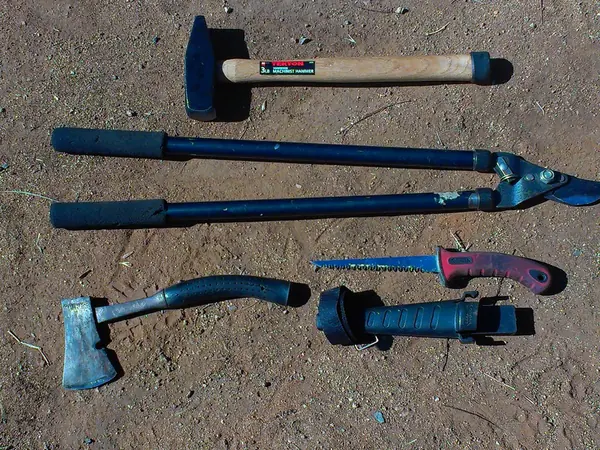
Representative photo. Check the retailer listing for the exact model, color and size.
Photo: THOR's hammer, lopper, hatchet and pruning saw IMAG0257 by el cajon yacht club, CC BY 2.0
Silky's fast, curved, taper-ground saw for climbers and pro pruners.
The Silky Sugoi hand saw is a curved, taper-ground arborist saw known for cutting very fast with clean results. Many climbers consider the Silky Sugoi Pro 330 arborist hand saw the standard for work aloft.
Sugoi means amazing in Japanese, and the name fits the way it cuts. The blade is curved, so it pulls itself into the wood on each stroke, and it is taper ground, thinner at the back than at the teeth. That taper reduces binding in the kerf, so the saw keeps moving on green wood and big limbs.
The teeth are large and impulse hardened, which keeps them sharp for a long time. The result is a Silky arborist saw that handles limbs many climbers would otherwise reach for a top-handle saw to cut.
The handle is rubberized and shaped to fill the hand, which helps control on long cuts and keeps the saw from twisting when you hit a knot.
That cutting speed is why the Silky Sugoi hand saw shows up on the saddles of so many climbers. When you can finish a cut quickly with a hand saw, you avoid starting a chainsaw in an awkward position and reduce the time you spend reaching out on a limb.
The Sugoi Pro 330 is the most popular length for climbing. It is long enough for real limbs and short enough to manage on a saddle. The 360 and 420 mm versions add reach and capacity for removal work and big pruning cuts, at the cost of a longer scabbard.
If your saw is getting dull, a Sugoi replacement blade brings it back without replacing the handle.
Silky also uses tooth patterns suited to green wood, which is what climbers cut most. On dry, dead wood, the saw still cuts fast but the teeth wear quicker.
Let the saw do the work. Use long, smooth pull strokes and light pressure. On bigger limbs, make an undercut first to stop bark tearing, then finish from the top. Avoid twisting the blade in the kerf, which can kink it.
Keep your free hand and climbing line out of the cutting path, and plan where the piece will fall before you cut.
On larger limbs, use your free hand to steady yourself, not to hold the limb near the cut. Let the piece fall clear rather than trying to catch it.
The Sugoi comes with a scabbard that clips to a belt or saddle. Put the saw away every time you move in the tree. Clean resin off the blade after work and wipe on a little oil to prevent rust.
Hand saws are sharp enough to cause serious cuts. Keep the blade in its scabbard when not cutting, wear gloves, and cut away from your body and your climbing line. Follow ANSI Z133 and get trained before cutting aloft.
Replace the scabbard if the retention weakens, and keep the saw on the side of your saddle that suits your cutting hand.
| Blade length | 330 mm (also 360 and 420 mm) |
|---|---|
| Blade shape | Curved, taper-ground |
| Cut | Pull stroke |
| Teeth | Impulse-hardened |
| Handle | Rubberized grip |
| Scabbard | Included |
Specs are from the manufacturer's published figures where available. Confirm against the product listing before you buy.
The 330 mm is the most popular for climbing. Go longer for removals and larger limbs.
Sugoi teeth are impulse hardened and are normally replaced rather than sharpened.
For daily climbers and pro pruners, its speed and durability make it one of the most popular hand saws on tree crews.
Pairs well with
Silky
A straight-bladed 300 mm Silky pruning saw for clean, controlled cuts.
Silky
A pistol-grip, curved 330 mm Silky saw built for fast, aggressive cuts.
Silky
A 330 mm curved pull saw for climbers who prune and remove limbs all day.
Fanno
A US-made 13-inch pruning saw with a traditional wooden handle.
Jameson
A compact 11-inch straight pruning saw for small cuts and tight spaces.
Jameson
A full-size 13-inch pruning saw with a shaped grip for long days.
Jameson
A 13-inch pruning saw with a classic wooden grip.
Silky
A pocket-size Silky folding saw with a 130 mm blade and large teeth.
Silky Sugoi Hand Saw$105