Silky
Silky GomTaro Pro-Sentei 300mm Hand Saw
A straight-bladed 300 mm Silky pruning saw for clean, controlled cuts.
Typical $55
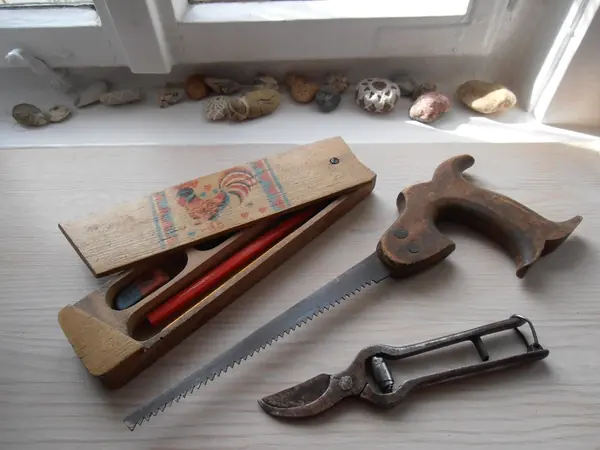 Hand Saws & Scabbards
Representative photo. Check the retailer listing for the exact model, color and size.
Photo: The stars must be in a very special position... by storebukkebruse, CC BY 2.0
A 330 mm curved pull saw for climbers who prune and remove limbs all day.
The Silky Zubat is the curved hand saw a lot of climbers reach for once a branch is too big for pruners but too small to justify the top-handle. The 330 mm blade cuts fast on the pull stroke and the curve keeps the teeth biting when you are reaching overhead. It rides in its own scabbard on the saddle and takes a replacement blade when the teeth are done.
On a prune or a crown clean, most cuts are in the 1 to 4 inch range. That is exactly where a Silky saw zubat pays off. The curved blade pulls itself into the wood, so you are not muscling it from an awkward position, and the long stroke means fewer passes before the limb drops.
Because it cuts on the pull, the blade stays in tension and is less likely to buckle when you are working at arm's length. Climbers who do a lot of reduction work like that it lets them make clean cuts at the branch collar without starting the saw. It is also the saw you want for dead-wooding near a client's roof, where a chainsaw is more noise and risk than the job needs.
The Zubat uses big, aggressive teeth that remove wood quickly in green hardwood and softwood. The cut finish is rougher than a fine-tooth pruning saw, but on most arborist work speed matters more than a glassy face. If you do a lot of fine ornamental pruning, keep a smaller saw for that work and use the Zubat for anything structural.
The teeth are impulse-hardened, which keeps them sharp a long time but means they are not meant to be filed. When the blade gets dull or kinked, swap in a replacement blade. The handle and scabbard last through several blades if you look after them.
Compared with straight-blade saws, the curve has another advantage: it keeps the cutting edge in contact with the wood as your arm swings through its natural arc. You get more cutting per stroke and less skating on the bark, which is why the Zubat is a common pick for anyone asking for a dedicated silky arborist saw.
The scabbard has a belt loop and clips onto most saddles. Mount it on the side opposite your lanyard so the handle is easy to reach without tangling. A short tether through the handle hole is cheap insurance if you work over a driveway, a pool or people on the ground. Keep the saw sheathed whenever you are moving through the tree, and keep your climbing line and lanyard out of the cutting path, since a sharp pull saw goes through rope as easily as wood.
For more options, see our full range of hand saws and scabbards, including straight blades and longer saws for removal work.
If you climb for a living and your current hand saw is slowing you down, this is the standard upgrade. Ground workers clearing brush and plant health care crews doing structural pruning also get a lot out of it. Beginners do fine with it too, but respect the teeth: they will open up a glove or a leg in a hurry, so keep cuts away from your body and your lines.
| Blade length | 330 mm (13 in) |
|---|---|
| Blade shape | Curved |
| Cutting stroke | Pull |
| Teeth per 30 mm | 7.5 |
| Replaceable blade | Yes |
| Scabbard | Included |
Specs are from the manufacturer's published figures where available. Confirm against the product listing before you buy.
Not practically. The teeth are impulse-hardened and are designed to be replaced rather than filed. Replacement blades fit the original handle.
Yes. It is one of the most common arborist saws on a saddle because it cuts fast, rides in a secure scabbard and is light enough to carry all day.
It is most efficient on limbs from about 1 to 6 inches. Beyond that, a top-handle chainsaw is usually the faster and safer choice.
No. Like most Japanese-style saws, the Zubat cuts on the pull. Let the pull do the work and use the push stroke only to reset.
Pairs well with
Silky
A straight-bladed 300 mm Silky pruning saw for clean, controlled cuts.
Silky
A pistol-grip, curved 330 mm Silky saw built for fast, aggressive cuts.
Silky
Silky's fast, curved, taper-ground saw for climbers and pro pruners.
Fanno
A US-made 13-inch pruning saw with a traditional wooden handle.
Jameson
A compact 11-inch straight pruning saw for small cuts and tight spaces.
Jameson
A full-size 13-inch pruning saw with a shaped grip for long days.
Jameson
A 13-inch pruning saw with a classic wooden grip.
Silky
A pocket-size Silky folding saw with a 130 mm blade and large teeth.
Silky Zubat 13" Curved Hand Saw$89