Notch Equipment
Notch Magneato Rope Runner Tether
A magnetic-catch tether that keeps your rope runner tidy and close at hand.
Typical $39
 Climbing Kits
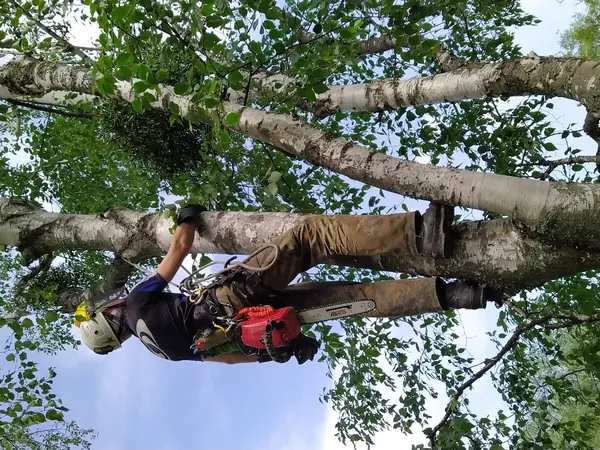
Representative photo. Check the retailer listing for the exact model, color and size.
Photo: Arborist climbing on the tree by Yuliya Krasylenko, CC BY 4.0
A matched set of tree climbing gear to get you up and working on rope.
A tree climbing kit puts the core tree climbing gear an arborist needs in one package: saddle, climbing rope, friction hitch cord, carabiners, pulley and lanyard. Buying a kit means the parts are chosen to work together and nothing is left out.
A typical arborist climbing kit includes a saddle, a length of arborist climbing rope, a friction hitch cord, locking carabiners, a hitch-tending pulley, and a lanyard or flip line. Some kits add throw line and a weight, a rope bag or a helmet.
The value of a kit is fit. The rope diameter suits the hitch cord, the carabiners suit the saddle bridge, and the pulley suits the hitch. Piecing a set together yourself is fine, but it is easy to end up with parts that do not work well together.
Arborist climbing kits also save time at checkout. Instead of researching every carabiner and hitch cord separately, you start with a working set and learn what you like before upgrading pieces one at a time.
Kits suit new climbers building a first set, crews outfitting a new employee, and climbers who want a backup system for the truck. Experienced climbers often buy individual pieces, but a kit is still a quick way to set up a second climber.
Before buying, think about how you will climb. Moving rope (DdRT) setups are common for beginners and for pruning work. Stationary rope (SRT) is popular with experienced climbers for access. Check whether a kit includes the hardware for the system you plan to use.
If you are outfitting a crew, consider standardizing on one arborist tree climbing kit. When every climber uses the same system, it is easier to inspect gear, train new climbers and perform an aerial rescue, because everyone knows how the other climber's system works.
Saddle fit matters most. Measure your waist and legs and check the saddle's size range. Next look at rope: length should be at least twice the height of the trees you climb, plus some spare. Make sure every carabiner is a locking model suitable for life support.
Add a helmet, eye protection and a hand saw if they are not included. A starter throw line kit is the next thing most new climbers add.
Check what the kit leaves out as well. Common extras include a rope bag, a second lanyard, and a throw line cube. Plan your budget so the essentials are covered before you spend on upgrades.
Climbing gear is life-support equipment. Every part should meet ANSI Z133 and the applicable product standards, and you should follow each manufacturer's instructions. Inspect your system before every climb and retire anything damaged.
A kit does not replace training. Learn to climb with a qualified instructor or experienced climber, practice aerial rescue, and never climb alone.
Build your inspection routine around the kit from day one. Check the saddle stitching, rope sheath, hitch cord and carabiner gates before each climb, and keep a simple log of when each piece went into service.
| Includes | Saddle, climbing rope, hitch cord, carabiners, pulley, lanyard |
|---|---|
| System | Moving rope (DdRT); SRT parts vary by kit |
| Carabiners | Locking, for life support |
| Intended use | Tree climbing and work positioning |
| Add-ons to consider | Helmet, throw line kit, hand saw |
Specs are from the manufacturer's published figures where available. Confirm against the product listing before you buy.
Yes, as long as the beginner is being trained. A kit removes the guesswork of matching parts.
At least twice the height of the tallest tie-in you expect, plus a margin. Many climbers start with 120 to 150 feet.
Some kits are set up for SRT or include parts that work for both. Check the contents before buying.
Pairs well with
Notch Equipment
A magnetic-catch tether that keeps your rope runner tidy and close at hand.
Husqvarna
Auto-locking D-shaped carabiner for arborist climbing kits.
Gap Arborist Supply
Stretchy saw tether that keeps a top-handle saw on your saddle.
Weaver
Modular bungee saw tether from Weaver for climbers.
Gecko
Fresh cuff pads to keep Gecko spurs comfortable on removals.
Petzl
Petzl's assisted-braking belay device for single ropes 8.5 to 11 mm.
Petzl
GriGri with anti-panic lowering and a lead/top-rope mode selector.
Petzl
Simple aluminum figure 8 descender for rappelling and lowering.
Arborist Rope Climbing Kit$899