Silky
Silky GomTaro Pro-Sentei 300mm Hand Saw
A straight-bladed 300 mm Silky pruning saw for clean, controlled cuts.
Typical $55
 Hand Saws & Scabbards
Representative photo. Check the retailer listing for the exact model, color and size.
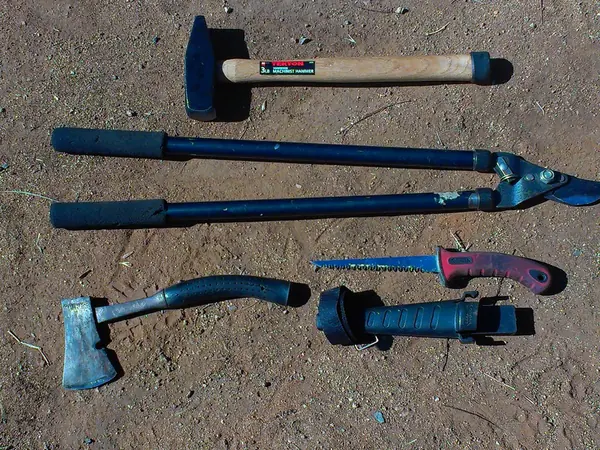
Photo: THOR's hammer, lopper, hatchet and pruning saw IMAG0257 by el cajon yacht club, CC BY 2.0
A compact folding pruning saw with a Tri-Cut blade for ground and light climbing work.
The Jameson Folding Tri-Cut Hand Saw uses a Tri-Cut tooth pattern that cuts on the pull stroke and clears chips well in green wood. It folds closed, so it rides in a pocket or pouch without a scabbard.
A folding saw is the one you keep in your pocket for small jobs: clearing suckers, cutting a branch that caught in the chipper chute, trimming a shrub while the climber is up. The Jameson folding Tri-Cut is light and cheap enough that losing one does not ruin the day.
The Tri-Cut pattern has three bevels on each tooth and cuts on the pull, so you are not pushing a thin blade into the wood. For bigger limbs or full-time climbing, step up to a fixed blade from our hand saws and scabbards.
Ground workers like having a folder on them because there is always a small cut to make between loads: a branch that will not lie flat on the brush pile, a root in the way of a stump grinder, or a stub left behind after a limb comes down. A folding saw handles those jobs without walking back to the truck.
Make sure the blade is fully open and locked before cutting, and keep your free hand out of the cut line. Close the saw when you are done rather than tossing it open into a bucket or truck bed.
Wipe off sap and moisture at the end of the day. If the pivot gets stiff, clean it and add a drop of light oil. When the teeth go dull, replacing the saw is usually more practical than trying to file a hardened pruning blade.
| Blade type | Tri-Cut |
|---|---|
| Design | Folding |
| Cut stroke | Pull |
Specs are from the manufacturer's published figures where available. Confirm against the product listing before you buy.
It works for light pruning, but many climbers prefer a fixed-blade saw in a scabbard because it is quicker to draw and put away with one hand.
It is a tooth pattern with three cutting edges per tooth that cuts on the pull stroke and clears chips well in green wood.
Pairs well with
Silky
A straight-bladed 300 mm Silky pruning saw for clean, controlled cuts.
Silky
A pistol-grip, curved 330 mm Silky saw built for fast, aggressive cuts.
Silky
Silky's fast, curved, taper-ground saw for climbers and pro pruners.
Silky
A 330 mm curved pull saw for climbers who prune and remove limbs all day.
Fanno
A US-made 13-inch pruning saw with a traditional wooden handle.
Jameson
A compact 11-inch straight pruning saw for small cuts and tight spaces.
Jameson
A full-size 13-inch pruning saw with a shaped grip for long days.
Jameson
A 13-inch pruning saw with a classic wooden grip.
Jameson Folding Tri-Cut Hand Saw$32