Notch Equipment
Notch Magneato Rope Runner Tether
A magnetic-catch tether that keeps your rope runner tidy and close at hand.
Typical $39
 Climbing Gear
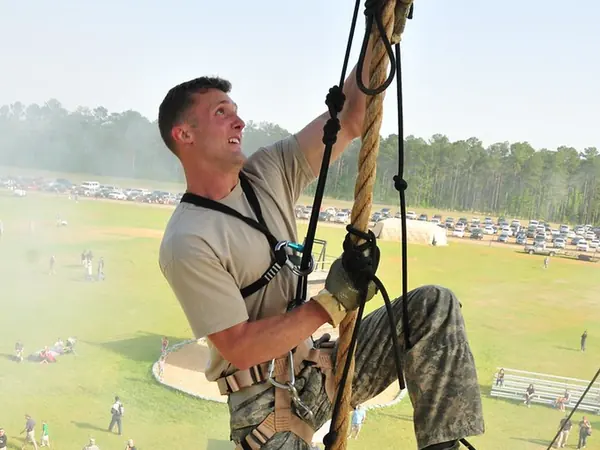
Representative photo. Check the retailer listing for the exact model, color and size.
Photo: D75_8819-1 by Mark F. Levisay, CC BY 2.0
Slings, rings and hardware that anchor a single rope system at the base or canopy.
An SRS anchor is the point your stationary rope hangs from, either tied off at the base of the tree (basal anchor) or set high in the canopy (canopy anchor). This page covers the slings, rings, friction savers and retrievable setups climbers use to build both, and what to check before you trust one with your weight.
With a single rope system, your rope stays still and you move on it. The anchor is whatever holds the top of that system. A basal anchor runs the rope up and over a union in the canopy and back down to a tie-off at the base of the tree. A canopy anchor ties or rigs the rope directly to the tree high up, usually around a stem with a sling or a cambium saver.
Basal setups are popular because they are retrievable and can be rigged to release from the ground, which makes rescue and retrieval easier. The tradeoff is that the load at the redirect over the limb can be close to double your weight, so the union you choose has to be sound and the right size. Canopy anchors put less load on the union but you have to climb to install them or isolate them carefully with a throw line.
Many climbers mix both. They may ascend on a basal anchor to get into the tree, then set a canopy anchor or move to a moving rope system for the work itself.
Most anchors are built from a handful of parts: a sling or eye-to-eye loop that goes around the stem, a ring or carabiner to connect the climbing line, and often a friction saver to protect the bark and the rope. Ground-based basal setups add a releasable hitch or device at the base and a second connector for the tail.
Pick components that are rated for life support and that match each other: ring sizes that pass the hardware you need, slings long enough for the stem diameter, and connectors that load along their major axis. Avoid mixing gear when you are not sure how the pieces interact.
Keep your anchor kit simple and consistent. When every sling, ring and connector is the same from tree to tree, you build it faster and spot problems sooner.
Every anchor is life-support gear. Use it only as described by the manufacturers, inside a system that meets ANSI Z133, and only after you have been trained to set up and rescue from SRS. Inspect slings for cuts and glazing, rings and connectors for burrs and wear, and look over the tree itself for decay, cracks and dead wood before you commit to an anchor point.
Test every anchor with a bounce test from the ground before you leave it, and plan how you would lower or rescue a climber from it before anyone ascends. A releasable basal setup is a strong habit to build for exactly that reason.
Consider the tree's structure as part of the system. A sound union in a healthy stem is just as important as the rated strength of any hardware you hang from it.
Many climbers carry a dedicated anchor kit: a couple of slings of different lengths, a few rings, a friction saver and spare connectors. Browse anchor hardware and related gear in our climbing gear section.
If you are new to SRS, start with a simple, well-tested setup from a trainer and only add components once you understand what each one does.
| Type | SRS anchor components and kits |
|---|---|
| Anchor styles | Basal and canopy |
| Typical parts | Slings, rings, friction savers, connectors |
| Use | Stationary rope tree climbing |
| Standard | Use life-support rated components only |
Specs are from the manufacturer's published figures where available. Confirm against the product listing before you buy.
A properly built basal anchor is a common SRS setup, but the redirect union sees more load than with a canopy anchor. Choose a sound, appropriately sized union and use rated components.
It is not always required, but a friction saver or cambium saver protects both the tree and the rope and gives more predictable friction.
A releasable setup lets someone on the ground lower the climber by releasing the tie-off at the base in a controlled way. Learn and practice it with a qualified trainer.
Pairs well with
Notch Equipment
A magnetic-catch tether that keeps your rope runner tidy and close at hand.
Husqvarna
Auto-locking D-shaped carabiner for arborist climbing kits.
Gap Arborist Supply
Stretchy saw tether that keeps a top-handle saw on your saddle.
Weaver
Modular bungee saw tether from Weaver for climbers.
Petzl
Petzl's assisted-braking belay device for single ropes 8.5 to 11 mm.
Petzl
GriGri with anti-panic lowering and a lead/top-rope mode selector.
Petzl
Simple aluminum figure 8 descender for rappelling and lowering.
SRS Basal and Canopy Anchors$95