Petzl
Petzl GriGri Belay Device
Petzl's assisted-braking belay device for single ropes 8.5 to 11 mm.
Typical $109
 Ascent & Descent
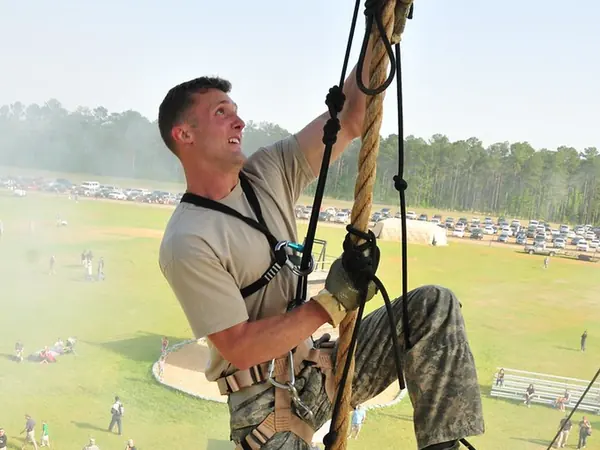
Representative photo. Check the retailer listing for the exact model, color and size.
Photo: 2011 Best Ranger Competition [Image 2 of 5] by DVIDSHUB, CC BY 2.0
Handled rope clamp for SRS ascents on 8 to 13 mm rope.
The Petzl Ascension is a handled ascender, the Petzl ascender most arborists picture when they think of a jumar. It grips single rope from 8 to 13 mm and is a staple of SRS ascent systems for climbing rope quickly into the canopy.
A hand ascender slides up the rope freely and locks when weighted downward. The toothed cam bites into the rope cover, so the clamp holds your weight while you move a foot ascender or a knee ascender up. A safety catch keeps the cam from opening accidentally.
On an arborist SRS ascent, the Ascension is typically paired with a foot ascender and a chest ascender or a hip-mounted device, or used in a rope walker or frog system. It is the hand-held link that lets you stand and push up efficiently.
The handle is shaped for gloved hands and a firm, comfortable grip during repeated strokes. The 8 to 13 mm rope range covers almost every arborist climbing line. Choose the hand version you will grip with: right-hand for most climbers, left-hand if you lead with your left.
Hand ascenders like this, sometimes called a jumar, are also used for rope rescue and tensioning systems. For fall protection, pair it with a device approved for life-support use within your system.
Many climbers choose the Ascension because it is one of the most widely used hand ascenders, so spare parts, accessories, and training resources are easy to find. The design has been refined over many years and is familiar to most trainers.
An ascender is for ascending, not for fall arrest. A shock load on a toothed cam can damage the rope sheath or the device. Keep slack out of the system, and do not climb above your ascender with a loose connection.
Ascend and descend only with a system you have been trained on. Your SRS should include a device that lets you descend and a way to transition safely. Pair it with a rope wrench or other SRS device for work positioning.
Life-support gear must meet the applicable standard (ANSI Z133 and the manufacturer's instructions), be inspected before every climb, and be used only by trained climbers.
Before you ascend, check that the cam is closed on the rope and the safety catch is engaged. Keep the ascender connected to your harness with a lanyard or tether so it cannot be dropped or lost.
Check the cam teeth for wear and packed sap or dirt, which reduce grip. Confirm the cam spring snaps closed, the safety catch works, and the frame is not cracked or bent. Clean with warm water and let it dry fully. Retire it if teeth are worn flat or the frame is damaged.
Store it dry and away from chemicals. If it has been dropped from height or loaded severely, inspect it carefully before using it again.
Keep the hand ascender clipped to your system when not in use. Losing it mid-ascent is a real hazard, and dropping it can injure someone on the ground.
| Rope compatibility | 8 to 13 mm single rope |
|---|---|
| Type | Handled ascender (rope clamp) |
| Versions | Left-hand and right-hand |
| Cam | Toothed with safety catch |
| Use | SRS ascent, rope rescue |
Specs are from the manufacturer's published figures where available. Confirm against the product listing before you buy.
Single rope from 8 to 13 mm.
Choose the side you grip with. Most climbers use the right-hand version.
No. It is for ascending. Fall protection must come from devices approved for that use.
Pairs well with
Petzl
Petzl's assisted-braking belay device for single ropes 8.5 to 11 mm.
Petzl
GriGri with anti-panic lowering and a lead/top-rope mode selector.
Petzl
Simple aluminum figure 8 descender for rappelling and lowering.
Hitch Hiker
Hitch-based mechanical device for smooth MRS climbing.
Petzl
Petzl's mechanical prusik for MRS tree climbing.
Notch Equipment
An adjustable rope wrench for SRS climbers who want to dial friction to the rope.
Kong
A pocket-size Kong rope clamp for emergency ascending, hauling and rescue backup.
Petzl Ascension Hand Ascender$85