Petzl
Petzl GriGri Belay Device
Petzl's assisted-braking belay device for single ropes 8.5 to 11 mm.
Typical $109
 Ascent & Descent
Representative photo. Check the retailer listing for the exact model, color and size.
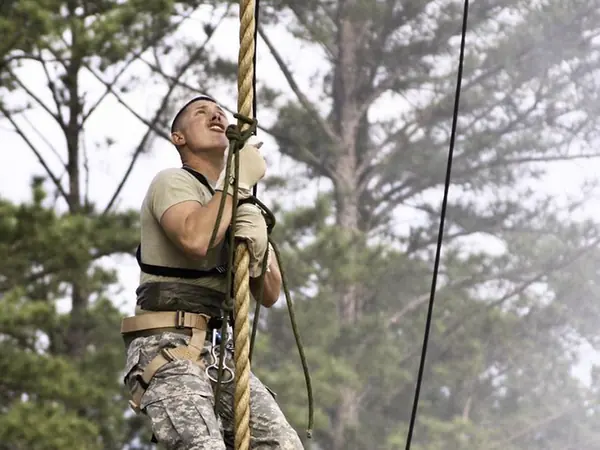
Photo: Prusik climb by Georgia National Guard, CC BY 2.0
A pocket-size Kong rope clamp for emergency ascending, hauling and rescue backup.
The Kong Duck ascender is a compact, handle-free rope clamp that climbers carry for emergency ascending, short hauls and rescue setups. It weighs next to nothing, clips to a gear loop and goes on the rope without taking anything else off it.
The Duck is the clamp you forget about until the day you need it. It is small enough to live on your saddle permanently, and it goes onto the rope in seconds. Climbers use it to build a quick foot loop for an emergency ascent, to grab a rope for a short mechanical advantage haul, or to add a backup in a rescue setup.
Because it has no handle, it is not a replacement for a full handled ascender on a long rope walk. Think of it as a utility clamp and a get-out-of-trouble tool.
Tree crews that train for aerial rescue often carry a Duck alongside a pulley and a few slings. With a pulley like the one on the Petzl Rollclip, it turns into a simple hauling system to take weight off a stuck or injured climber's line.
The value is in having it with you and knowing how to use it. Practice the systems you plan to use on the ground with a qualified trainer before you rely on them aloft.
A small toothed cam can damage a rope if it is shock loaded, so keep slack out of any system built on the Duck and never use it where a fall onto it is possible unless the manufacturer specifically allows that configuration.
Check the cam teeth for wear and packed debris, make sure the spring snaps the cam back, and look for cracks or sharp edges on the body. Life-support gear has to meet the applicable standard and the manufacturer's instructions, get inspected before every climb, and be used only by trained climbers.
If the Duck has been loaded hard, for example in a rescue or a haul that shock loaded, inspect it closely before carrying it again and retire it if you have any doubt.
Most climbers clip the Duck to a rear gear loop with a dedicated locking carabiner so it is always in the same place. It weighs so little that there is no reason to leave it in the truck.
Pair it with a short sewn sling or a prusik loop as a foot loop, a small pulley and a spare locking carabiner, and you have the core of an emergency ascent or a simple haul. If you ever need to get off a stuck system, climb past a jammed hitch or lift a co-worker's weight, those few pieces cover a lot of problems.
On the ground it earns its keep too. Use it to put a little tension on a tag line, to hold a pull line while you take a wrap on a tree, or to grab a rope when you need a hand-hold for a short haul of brush up a bank.
| Type | Non-handled rope clamp |
|---|---|
| Rope diameter | 8 to 13 mm (check device markings) |
| Attachment | Locking carabiner, sold separately |
| Primary use | Emergency ascent, hauling, backup |
| Body | Aluminum with steel cam |
Specs are from the manufacturer's published figures where available. Confirm against the product listing before you buy.
It is a compact rope clamp. It can be used for ascending, but it has no handle, so most climbers treat it as an emergency and utility tool rather than their main ascender.
It covers a wide range of common climbing line diameters. Check the markings on your device and Kong's instructions for the exact range.
Yes, it is commonly used as the rope grab in simple mechanical advantage hauls. Keep the system slack-free and follow the manufacturer's limits.
Inspect the cam teeth, spring action, axle and body before each use. Retire it if teeth are worn flat, the spring is weak or the body is cracked or deformed.
Pairs well with
Petzl
Petzl's assisted-braking belay device for single ropes 8.5 to 11 mm.
Petzl
GriGri with anti-panic lowering and a lead/top-rope mode selector.
Petzl
Simple aluminum figure 8 descender for rappelling and lowering.
Hitch Hiker
Hitch-based mechanical device for smooth MRS climbing.
Petzl
Petzl's mechanical prusik for MRS tree climbing.
Notch Equipment
An adjustable rope wrench for SRS climbers who want to dial friction to the rope.
Kong Duck Emergency Belay Device$45