Gap Arborist Supply
Tree Support Web for Staking Trees, 250 ft
Soft, wide staking web on a roll for supporting newly planted trees.
Typical $45
 Planting
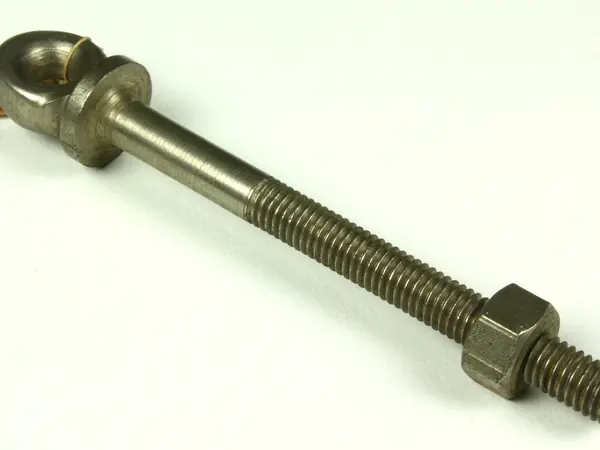
Representative photo. Check the retailer listing for the exact model, color and size.
Photo: Eye Bolt - Basil Watson's Sopwith-Type Biplane, Melbourne, Victoria, 1916 by Photographer: David Thompson, CC BY 4.0
Drive-in earth anchors for guying smaller newly planted trees.
Small duckbill anchors are drive-in earth anchors that let you guy a newly planted tree without wooden stakes. You drive the anchor into the ground with a drive rod, pull back on the cable, and the anchor turns sideways in the soil and locks. They are quick to set and out of the way once installed.
A duckbill earth anchor looks like a small metal bill with a cable attached. You set it on the end of a drive rod and hammer it into the ground at an angle away from the tree. Pull the rod out, then pull up hard on the cable. The anchor pivots crosswise in the soil, like a toggle bolt in drywall, and resists further pulling.
That load-lock step matters. An anchor that has not turned holds very little. Pull until you feel it set before attaching the guy to the tree.
The design is simple and that is the appeal. There are no stakes sticking up for kids or mowers to hit, and the only thing left above ground is the guy cable running to the trunk. On a commercial planting with many trees, a crew can set a set of duckbill earth anchors in minutes per tree.
For most trees, three duckbill anchors spaced evenly around the root ball give support from every direction. Keep the anchors outside the root ball, and run each guy to a soft collar or strap on the trunk, never bare wire on bark.
Leave a little slack so the tree can move. Terminate the cable with a thimble and wire rope clamps or the hardware supplied in a duckbill anchor kit.
Angle the guys so they meet the trunk at roughly one-third to two-thirds of its height, with the anchor far enough out to give a reasonable angle. Flag the guys with tape or covers so people do not walk into them.
Holding power depends on soil. Dense clay holds well; loose sand and wet soil hold less. Small anchors are for small trees. For larger caliper trees, step up to a bigger anchor size and check the maker's chart.
Call before you dig. Driving anchors into buried utility lines is a real hazard, so get locates done first.
A duckbill anchor kit typically includes the anchors with cable attached and the hardware to terminate them. Check what your kit includes and whether you need a drive rod, which is reusable and worth keeping in the truck.
Plan to remove guys after a season or so, once the roots have established. Cut the cable at ground level and leave the anchor in place, or dig it out if the site needs it clear.
If the tree still moves too much at removal time, check the planting depth and root ball before you add the guys back. Guying cannot fix a tree planted too deep or a root ball that has fallen apart. Note anchor locations on the work order so the next crew knows where the cable runs are, especially near lawns that get aerated.
| Type | Drive-in earth anchor |
|---|---|
| Size | Small |
| Install | Drive rod, then load-lock by pulling up |
| Typical layout | Three anchors spaced around the tree |
| Holding | Depends on soil type; see maker's chart |
Specs are from the manufacturer's published figures where available. Confirm against the product listing before you buy.
Drive them to the depth the maker specifies for the size, then load-lock. Deeper generally holds better in firm soil.
Three, spaced evenly around the tree, is the common setup.
They are generally treated as single-use once set. Cut the cable and leave the anchor buried when removing guys.
Pairs well with
Gap Arborist Supply
Soft, wide staking web on a roll for supporting newly planted trees.
Gap Arborist Supply
Galvanized U-bolt wire rope clips for guying trees and making eyes in cable.
Duckbill
Steel drive rod for setting the larger Duckbill earth anchors when guying trees.
Gap Arborist Supply
Threaded rods for bracing weak unions and split stems in trees.
Gap Arborist Supply
Galvanized steel strand for general-purpose, non-critical uses.
Gap Arborist Supply
Extra-high-strength galvanized steel strand for tree support systems.
Gap Arborist Supply
A 3/8 in eye bolt for anchoring light cabling systems in trees.
Gap Arborist Supply
A galvanized lag eye for anchoring light cable systems in small to medium limbs.
Duckbill Earth Anchors, Small$39