Gap Arborist Supply
Tree Support Web for Staking Trees, 250 ft
Soft, wide staking web on a roll for supporting newly planted trees.
Typical $45
 Planting
Representative photo. Check the retailer listing for the exact model, color and size.
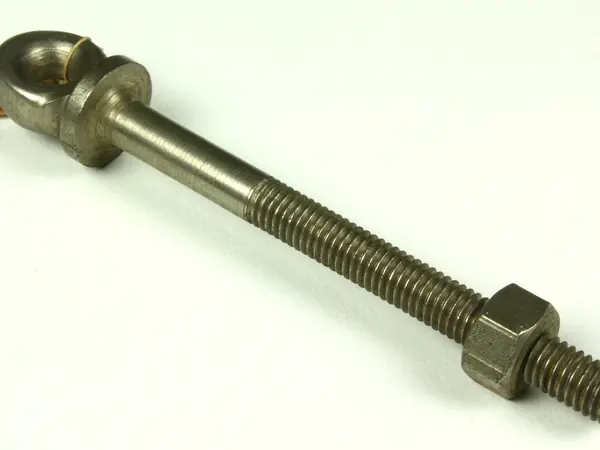
Photo: Stainless steel eye-bolt by Unknown, CC0
Galvanized U-bolt wire rope clips for guying trees and making eyes in cable.
Wire rope clamps, also called wire rope clips or cable clamps, let you form an eye or join wire cable without swaging tools. On tree jobs they show up when guying newly planted trees to earth anchors or making temporary cable terminations. They are cheap and simple, but only work when installed the right way around and torqued.
In the planting world, wire cable clamps are the quick way to terminate guy cable on larger transplanted trees: cable from a collar on the trunk, down to an earth anchor, with a thimbled eye clamped at each end. They also come in handy for temporary cable work around the yard and shop.
For permanent tree cabling inside the canopy, preformed dead-ends are the usual termination. Pair clamps with duckbill earth anchors when you are guying from the ground.
Around the shop, clamps also hold a cable on a winch line or make a quick eye on a sling for dragging logs. Keep a few sizes in the truck with matching thimbles.
The U-bolt goes on the dead end, the short tail. The saddle sits on the live end, the side that carries the load. Install a clip backward and the U-bolt crushes the loaded cable and cuts its strength a lot. Every clip on the run goes the same way.
Use a thimble in the eye so the cable does not kink around a tight bend. Put the first clip one saddle-width from the dead end, the next tight against the thimble, and any others evenly between.
Seat the cable fully into the thimble groove before tightening the first clip, and keep the thimble from rotating or falling out as you go. A loose thimble lets the eye collapse under load. Tighten the nuts evenly, alternating sides, so the saddle pulls down square on the cable rather than cocking to one side.
Use the right size. An oversized clip will not grip a small cable, and an undersized one will not close over the larger cable at all.
Each size has a minimum number of clips, a turnback length and a torque value published by the maker. Small cables usually need at least two clips and larger ones more. Follow the table that ships with the clamps rather than guessing.
Torque the nuts, put the cable under load, then retorque. Cable stretches and settles, and loose clips let the cable slip. Check guyed trees through the season and remove guying once the tree has rooted in.
Keep spare clamps dry and the threads clean. A rusty, galled thread will not reach the right torque, and that means a termination that can slip. Replace any clamp with a bent U-bolt or cracked saddle.
When you take a guy system down, inspect the cable where the clips sat. Crushed or kinked cable should not go back into service; cut it off and start fresh.
A clipped termination does not reach the full strength of the cable. That is fine for guying a tree. Do not use clipped terminations in life-support systems or as a substitute for rated rigging hardware.
| Type | U-bolt wire rope clip |
|---|---|
| Finish | Galvanized |
| Sizing | Match clip size to cable diameter |
| Saddle placement | On the live (load) end |
| Count, spacing, torque | Per maker's table for each size |
Specs are from the manufacturer's published figures where available. Confirm against the product listing before you buy.
Nothing. Wire rope clamp, wire rope clip and cable clamp all describe the same U-bolt and saddle fitting.
The saddle goes on the live, load-bearing side of the cable. The U-bolt goes on the dead-end tail.
It depends on cable size. Use the maker's table; small cables generally take at least two clips, larger cables more.
Yes. Retorque after the first load and check them periodically.
Pairs well with
Gap Arborist Supply
Soft, wide staking web on a roll for supporting newly planted trees.
Duckbill
Drive-in earth anchors for guying smaller newly planted trees.
Duckbill
Steel drive rod for setting the larger Duckbill earth anchors when guying trees.
Gap Arborist Supply
Threaded rods for bracing weak unions and split stems in trees.
Gap Arborist Supply
Galvanized steel strand for general-purpose, non-critical uses.
Gap Arborist Supply
Extra-high-strength galvanized steel strand for tree support systems.
Gap Arborist Supply
A 3/8 in eye bolt for anchoring light cabling systems in trees.
Gap Arborist Supply
A galvanized lag eye for anchoring light cable systems in small to medium limbs.
Wire Rope Clamps$5