Gap Arborist Supply
Tree Support Web for Staking Trees, 250 ft
Soft, wide staking web on a roll for supporting newly planted trees.
Typical $45
 Planting
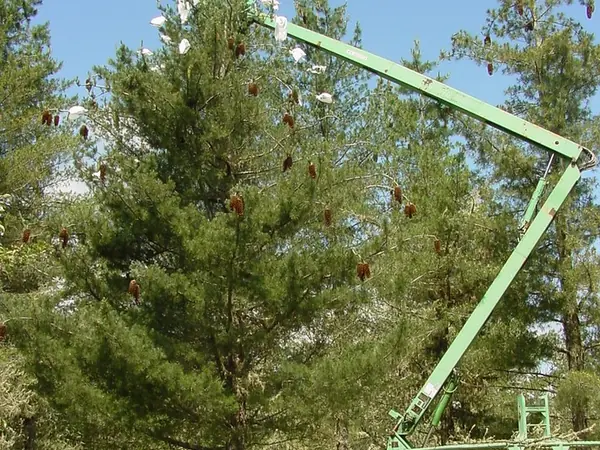
Representative photo. Check the retailer listing for the exact model, color and size.
Photo: 2003. Pollinating cones. by USDA Forest Service, Public domain
Steel drive rod for setting the larger Duckbill earth anchors when guying trees.
The large Duckbill drive rod is the steel rod used to drive the bigger Duckbill earth anchors into the ground for guying newly planted trees. Drive the anchor to depth, pull the rod, then load-lock the anchor.
Duckbill anchors are driven into undisturbed soil with a drive rod and a hammer or driver. Once at depth, the rod is pulled out and the cable is pulled up, which rotates the anchor sideways into a locked position. It is much faster than digging in deadmen, and the hole is small.
Larger anchors need the larger rod. Check the rod against the anchor model before you start, since the wrong rod will not seat or drive the anchor properly.
Keep the drive rod straight and clean, and mark it at the target depth so the crew knows when the anchor is set. A bent rod can bind or fail to release the anchor, so check it before each job.
Locate buried utilities before driving anything into the ground. Drive anchors outside the root ball, at an angle away from the tree. Use soft, wide straps against the trunk so the guying does not girdle the bark, leave some movement so the tree builds strength, and remove the guying once the tree is established, often after one growing season. Wear eye protection and gloves when driving. Find more planting supplies in our planting section.
Choose anchors and rods rated for the size of the tree, and follow the anchor maker's instructions for depth and load-locking.
| Brand | Duckbill |
|---|---|
| Type | Earth anchor drive rod |
| Fits | Larger Duckbill anchor models; confirm against your anchor |
Specs are from the manufacturer's published figures where available. Confirm against the product listing before you buy.
Use the rod size made for your anchor model. A mismatched rod may not seat the anchor.
Usually only until it is rooted in, often one growing season. Check and remove guying promptly.
Pairs well with
Gap Arborist Supply
Soft, wide staking web on a roll for supporting newly planted trees.
Gap Arborist Supply
Galvanized U-bolt wire rope clips for guying trees and making eyes in cable.
Duckbill
Drive-in earth anchors for guying smaller newly planted trees.
Gap Arborist Supply
Threaded rods for bracing weak unions and split stems in trees.
Gap Arborist Supply
Galvanized steel strand for general-purpose, non-critical uses.
Gap Arborist Supply
Extra-high-strength galvanized steel strand for tree support systems.
Gap Arborist Supply
A 3/8 in eye bolt for anchoring light cabling systems in trees.
Gap Arborist Supply
A galvanized lag eye for anchoring light cable systems in small to medium limbs.
Duckbill Drive Rod for Large Earth Anchors$50