Gap Arborist Supply
3/8 in Eye Bolt for Tree Cabling
A 3/8 in eye bolt for anchoring light cabling systems in trees.
Typical $7
 Cabling Hardware
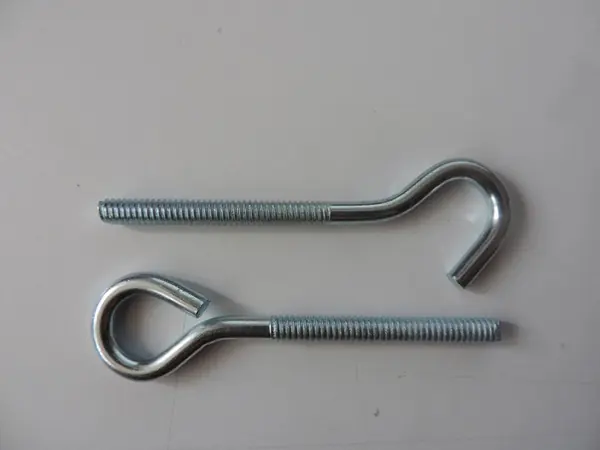
Representative photo. Check the retailer listing for the exact model, color and size.
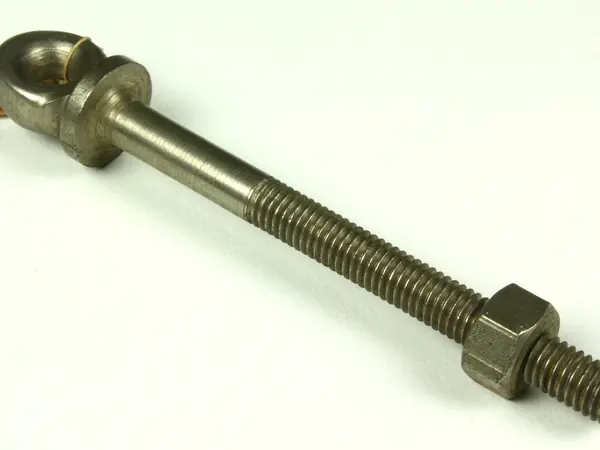
Photo: Eye Bolt by Clearly Ambiguous, CC BY 2.0
Hook-style lag anchors for cabling leads with a cable that wraps the J.
J-lag screws are threaded tree cabling anchors with an open J-shaped hook in place of a closed eye. You drill a pilot hole, thread the J-lag into sound wood, and seat the cable termination over the hook. Arborists like them because the cable can be hooked on after the anchor is set.
On a typical cabling job you set one anchor in each lead, then run cable between them about two-thirds of the way from the weak union to the tops of the leads. A J-lag gives you a hook to drop the thimbled cable end onto, which makes tensioning and final termination easier when you are working alone in the canopy.
Because it installs from one side, a J-lag saves you drilling through the whole lead. That is a real advantage on light systems in younger trees, where you want to keep wounding to a minimum.
J-lags also suit retrofit work. When an existing system needs a second cable or a replacement run, a hook anchor lets you set hardware, then bring the new cable to it and hang the termination without threading anything through a closed eye.
Keep the hardware matched: J-lag, thimble, dead-end and cable from systems that are meant to work together, with published ratings for each part.
A closed eye lag screw holds the termination captive. A J-lag lets you hook on after the fact, but the termination must stay seated against the hook. A lag stud, also called a lag-threaded rod, has lag thread on one end and machine thread on the other so you can add an amon-eye nut. All three rely on thread grip in the wood.
None of them match a through-bolt with a nut and washer on the far side for holding power. Choose the anchor by the published rating, the size of the lead and the load you expect, and follow ANSI A300 Part 3.
Drill the pilot hole in line with the cable so the hook pulls straight. Thread the J-lag in until the hook sits just clear of the bark, with the open side facing away from the cable's pull so the termination cannot slip off.
Inspect the wood before drilling and stay out of decay, cracks and included bark. Re-inspect cable systems on a schedule; growth and storms change what the system is doing. If you are learning cabling, get supervised experience first.
Clean up after yourself: brush shavings out of the hole before threading, and keep the work order notes clear on which lead got which anchor.
Every cable system needs follow-up. Leads grow, cables slacken or tighten, and storms can shift a termination off a hook if it was not seated properly. Put the tree on an inspection schedule and note the hardware type and install date on the work order.
On a re-inspection, look for the hook opening, any wear where the thimble rides, wood swelling over the J, and cracks or decay near the anchor. If the tree has outgrown a light system, replace it with heavier hardware rather than adding more of the same.
| Type | J-lag (hook) screw |
|---|---|
| Material | Galvanized steel |
| Thread | Lag thread |
| Head | Open J-shaped hook |
| Install | Pilot hole, single side |
| Standard | Install per ANSI A300 Part 3 and maker's instructions |
Specs are from the manufacturer's published figures where available. Confirm against the product listing before you buy.
Orient it so the cable pulls the termination into the bottom of the J, with the opening away from the line of pull.
No. Lag anchors depend on thread grip in wood. Use through-bolts for heavier loads or larger leads.
A rod with lag thread on one end and machine thread on the other. It takes an amon-eye nut, giving you an adjustable eye on a lag anchor.
Yes. Drill a pilot close to the thread's root diameter so the lag goes in straight and grips well.
Pairs well with
Gap Arborist Supply
A 3/8 in eye bolt for anchoring light cabling systems in trees.
Gap Arborist Supply
A galvanized lag eye for anchoring light cable systems in small to medium limbs.
Gap Arborist Supply
A 1/2 in. turnbuckle for fine tension adjustment in guying and support systems.
Gap Arborist Supply
A 5/8 in. eye bolt anchor for through-bolted tree cabling systems.
Gap Arborist Supply
A forged eye nut that turns threaded rod into a cable anchor point.
Gap Arborist Supply
Galvanized washers to seat nuts and eyes on through-bolted cabling hardware.
Preformed Line Products
Helical dead-ends for fast, clean termination of steel support cable.
Rig Guy
Beveled washer that seats cabling hardware evenly on a rounded stem.
J-Lag Screws$14