Buckingham
Buckingham Agility Saddle
A Buckingham climbing saddle aimed at climbers who value freedom of movement.
Typical $380
 Saddles & Harnesses
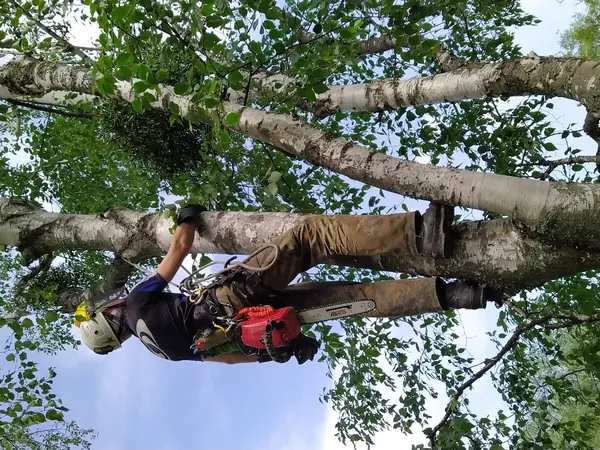
Representative photo. Check the retailer listing for the exact model, color and size.
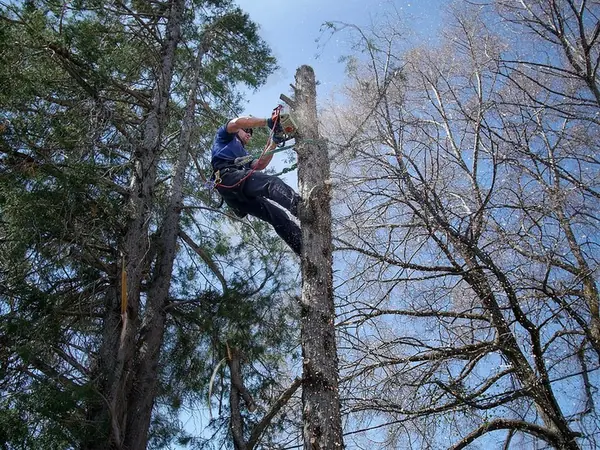
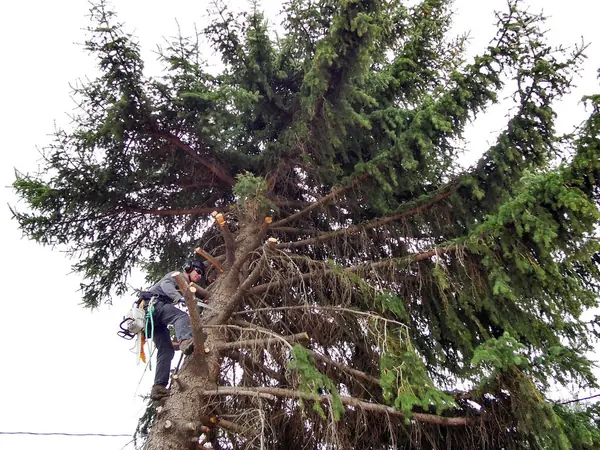
Photo: Arborist climbing on the tree by Yuliya Krasylenko, CC BY 4.0
A traditional American-style climbing saddle for everyday tree work.
The Weaver Cougar saddle is a traditional American-style tree climbing harness built for everyday pruning and removal work. It uses a padded back with side D-rings and leg straps, the layout a lot of climbers learned on.
American-style saddles like the Cougar keep things simple: a wide padded back, a pair of side D-rings, and leg straps. You clip your flipline across the D-rings for spur work, and you tie in at the D-rings or a bridge setup for climbing on a rope. Many climbers on removal crews still prefer this style because it is easy to check and quick to put on.
Gear loops around the belt carry a handsaw, a few slings, and carabiners. On a long pruning day you may want more leg support than a basic D-ring saddle gives, which is where a seat option like the Cougar with batten seat comes in.
A traditional D-ring saddle is also a good teaching saddle. New climbers can see every connection at a glance, and crew leaders can check a setup quickly from the ground. If you plan to add a rope bridge or ring later, confirm with Weaver which modifications the saddle allows.
Size by waist measurement with the clothes you will climb in, and check the leg straps fit snugly without pinching. Before every climb, inspect stitching, webbing, buckles, and D-rings for wear, cuts, or corrosion.
Life-support gear must meet the applicable standard (ANSI Z133 and the manufacturer's instructions), be inspected before every climb, and be used only by trained climbers.
| Type | Tree climbing saddle |
|---|---|
| Style | Traditional American, D-ring |
| Brand | Weaver |
Specs are from the manufacturer's published figures where available. Confirm against the product listing before you buy.
Yes. The side D-ring layout is a common setup for flipline work on removals.
Check Weaver's instructions for approved attachment points and configurations before setting up any SRS system on it.
Pairs well with
Buckingham
A Buckingham climbing saddle aimed at climbers who value freedom of movement.
Buckingham
A straightforward, supportive Buckingham saddle for working climbers.
Buckingham
A comfort-focused Buckingham saddle for climbers who log long hours aloft.
Petzl
A supportive tree care harness with a sliding bridge for all-day comfort.
Teufelberger
A semi-rigid, highly adjustable saddle for climbers who want support and options.
Edelrid
An elastic chest harness that pairs with the TreeRex saddle for efficient ascent.
Weaver
A simple Weaver chest harness that keeps your saddle and ascent gear in position.
DMM
DMM's Kinisi arborist saddle, built for climbers who spend all day in the tree.
Weaver Cougar Climbing Harness$260