Edelrid
Edelrid TreeRex Bungee Chest Harness
An elastic chest harness that pairs with the TreeRex saddle for efficient ascent.
Typical $45
 Saddle Parts & Chest Harnesses
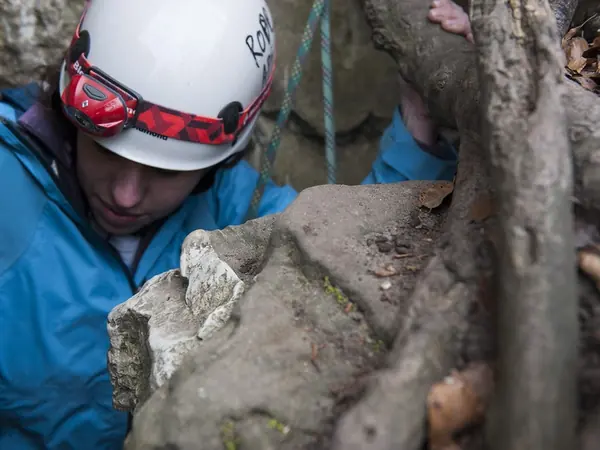
Representative photo. Check the retailer listing for the exact model, color and size.
Photo: 160320-F-QP401-181 by DoD News Photos, Public domain
A simple Weaver chest harness that keeps your saddle and ascent gear in position.
The Weaver Chest Box is a chest harness that pairs with a climbing saddle to keep it in position and hold ascent gear upright. It is a simple, low-cost way to add upper body support to a traditional saddle.
A climbing saddle sits around your hips and legs. When you climb a stationary rope, ascend for a long time or carry a heavy rack, the saddle can drift down and your ascender can flop forward. A chest harness ties the top of your system together so the saddle stays put and the ascender stays upright.
The Chest Box is a straightforward way to add that support. It connects to your saddle and adjusts to fit over your work clothes.
Climbers who carry a lot of gear on the saddle also find that a chest harness helps keep the load from pulling the waist belt down.
It is also helpful for climbers who carry a lot of hardware on the saddle, since it helps keep the waist belt from sliding down under the weight.
Remember that chest harnesses add another layer to your system, so practice putting it on and taking it off quickly. When it is part of your normal routine, it will not slow you down at the start of a job.
It suits climbers using Weaver and other traditional saddles who are adding a stationary rope technique, as well as anyone who wants a little more upper body support. If you are running a modern European saddle with its own chest harness, check whether a dedicated accessory exists for your model.
Browse more parts in saddle parts and shoulder harnesses, or see Weaver saddles.
Many climbers add a chest harness once they start using a rope walker or chest ascender setup, and keep it on their saddle even when they climb moving rope.
If you are new to stationary rope, get trained before using a chest ascender setup. Learning the ascent and the changeover to descent on the ground is the safest way to build the habit.
Adjust the harness so it is snug but does not restrict breathing or reach. Connect it to your saddle per the manufacturer's instructions and test on the ground. If you use a chest ascender, make sure it sits upright and the rope runs cleanly.
Know which parts of your system are life support and which are positioning only. A chest harness generally positions gear; do not use it as a primary attachment point unless the manufacturer says it is rated for that.
A chest harness that pinches or restricts your arms will come off by the end of the day, so take the time to adjust it with your work clothes on.
Check webbing, stitching and buckles for wear, cuts and chemical contamination before each climb, and retire the harness if you find damage. Keep it away from fuel and battery acid.
Anything you hang your life on must meet the applicable standard, be used per the manufacturer's instructions and ANSI Z133, and be inspected before every climb by a trained user.
Replace it if buckles slip or webbing shows heavy wear.
| Type | Chest harness |
|---|---|
| Brand | Weaver |
| Use | Saddle positioning and ascent |
| Compatible with | Many arborist saddles (check fit) |
| Typical price | About $50 |
Specs are from the manufacturer's published figures where available. Confirm against the product listing before you buy.
It fits many arborist saddles, but connection points vary. Check fit and the manufacturer's guidance before use.
Many SRS ascent systems use a chest ascender, which works best with a chest harness holding it upright.
Not unless it is rated as a life-support attachment. Most chest harnesses are for positioning only.
Pairs well with
Edelrid
An elastic chest harness that pairs with the TreeRex saddle for efficient ascent.
Tree Access
A simple chest harness that keeps your SRT ascent system tight and efficient.
Buckingham
A replacement bridge that keeps a Buckingham ErgoLite saddle in service.
Buckingham
Shoulder straps that retrofit to a Buckingham ErgoVation saddle.
Buckingham
A bridge for setting up an ErgoVation saddle for single-rope climbing.
Buckingham
Shoulder suspenders that carry tool weight on a compatible Buckingham saddle.
Edelrid
A replacement rope bridge for the Edelrid TreeRex saddle.
Petzl
An add-on seat for Petzl SEQUOIA saddles for long stretches hanging in the tree.
Weaver Chest Box Harness$50