Crosby
Crosby Chain Choker Hook
A choker hook that turns a length of chain into a sliding log choker.
Typical $25
 Rings & Hardware
Representative photo. Check the retailer listing for the exact model, color and size.
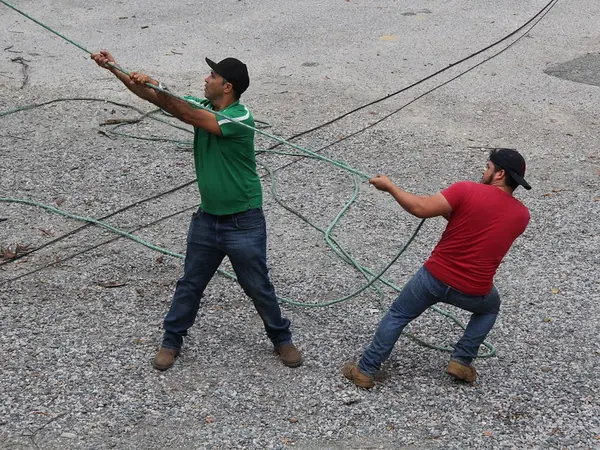
Photo: Tree Pruning in RVA (Carytown, Virginia) by Gamma Man, CC BY 2.0
The compact Basilisk size for light rigging, redirects, and small lowering setups.
The Tylaska LFB-10 Basilisk is a compact low-friction device for light rigging, redirects, and small lowering setups. It gives rope a smooth, machined surface to run over with nothing to spin or seize.
Tylaska is known for machined low-friction rings and fittings that started in sailing hardware and moved into tree work. The LFB-10 is the small end of the Basilisk range, so it suits lighter rope and smaller pieces rather than heavy removals.
A low-friction device sits between a pulley and a natural crotch. There are no bearings or sheaves, so it tolerates grit and sap well, and it is lighter than many blocks of similar size. The trade-off is more friction than a true pulley, which can help a groundie control a load but means more effort when hauling.
Many climbers also use low-friction devices for redirects and for small speedlines or retrievable setups, where a clean, snag-free surface matters more than raw efficiency. Because the device is a single machined piece, there are fewer things to check, but the rope-bearing surface still needs to stay smooth.
Pick a sling and connector rated for the loads you plan to put on the system, and confirm rope diameter compatibility with the manufacturer before you buy. Compare it with other rigging rings and hardware to see which style suits your work.
Check the rope-bearing surface for burrs, grooves, or rough spots that could damage rope, and retire the device if it is cracked or deformed. Rig only within the rated strength of every component in the system, inspect gear before each job, and make sure the crew is trained in rigging practice under ANSI Z133 and the manufacturer's instructions.
| Model | Basilisk LFB-10 |
|---|---|
| Brand | Tylaska |
| Type | Low-friction rigging device |
Specs are from the manufacturer's published figures where available. Confirm against the product listing before you buy.
No. It has no rotating sheave, so it adds some friction. That can be useful for controlling a lowering line, but a pulley is more efficient for hauling.
Check Tylaska's published specifications for this model. Rope fit and rated strength vary by size, and the manufacturer's figures are the ones to follow.
Pairs well with
Crosby
A choker hook that turns a length of chain into a sliding log choker.
Crosby
A forged connecting link for joining chain, hooks and rings in the field.
Gap Arborist Supply
A galvanized pinned connector for chain, cable and hitch work around the yard.
AMH
A hook with a wide saddle shaped for round slings in lifting and rigging.
Tylaska
A machined Tylaska friction block for building clean, low-wear rigging points.
Tylaska
The LFB-20 size of Tylaska's Basilisk low-friction device for rigging and redirects.
Tylaska
The LFB-28 size of Tylaska's Basilisk low-friction device for rigging and redirects.
Tylaska LFB-10 Basilisk Low-Friction Device$69