Crosby
Crosby Chain Choker Hook
A choker hook that turns a length of chain into a sliding log choker.
Typical $25
 Rings & Hardware
Representative photo. Check the retailer listing for the exact model, color and size.
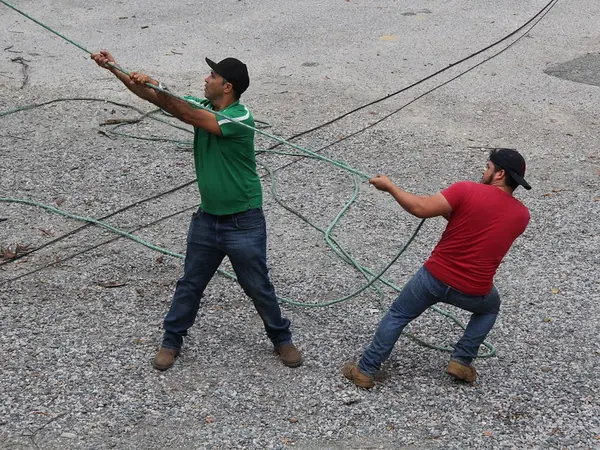
Photo: Tree Pruning in RVA (Carytown, Virginia) by Gamma Man, CC BY 2.0
A rigging ring from FTC for redirects, sling connections, and anchors.
The FTC Fioris ring is a rigging ring for tree work, used where a smooth, round bearing surface does a better job than a carabiner: as a low-friction redirect for light lines, a connection point for slings, or a retrievable anchor component. Rings have no gate to open, so they stay closed under any orientation.
A ring is the simplest piece of hardware in the kit and one of the most useful. Spliced or girth-hitched to a sling, it becomes a smooth redirect for a pull line or light rigging line with less heat and wear than running over bark. Paired with another ring, it can form part of a retrievable friction saver setup.
Rings add friction compared with a pulley, so they are better for light loads or where some friction helps. Check FTC's listed rating and use the ring with rope and slings it is designed for. Do not use it to catch heavy, falling wood unless the manufacturer rates it for that.
Rings are also easy to inspect and hard to misuse, since there is no gate to leave open or cross-load. That simplicity is why so many climbers carry a spare or two on the saddle for whatever comes up during the day.
Look for grooves worn by rope, cracks, and sharp edges, and retire a ring with deep wear that could cut a sling or rope. See other hardware in our rings and other hardware section.
Rigging forces are dynamic and can be several times the weight of the piece. Follow the manufacturer's ratings and ANSI Z133, inspect every component before the job, and keep rigging work to trained crews.
| Type | Rigging ring |
|---|---|
| Use | Redirects, sling connections, anchors |
| Gate | None (closed ring) |
Specs are from the manufacturer's published figures where available. Confirm against the product listing before you buy.
A pulley is more efficient. A ring is simpler, lighter, and adds friction, which can be useful for light loads and some lowering setups.
Retire it when rope grooves get deep, sharp edges appear, or you see cracks or deformation.
Pairs well with
Crosby
A choker hook that turns a length of chain into a sliding log choker.
Crosby
A forged connecting link for joining chain, hooks and rings in the field.
Gap Arborist Supply
A galvanized pinned connector for chain, cable and hitch work around the yard.
AMH
A hook with a wide saddle shaped for round slings in lifting and rigging.
Tylaska
A machined Tylaska friction block for building clean, low-wear rigging points.
Tylaska
The LFB-20 size of Tylaska's Basilisk low-friction device for rigging and redirects.
Tylaska
The LFB-28 size of Tylaska's Basilisk low-friction device for rigging and redirects.
Tylaska
The compact Basilisk size for light rigging, redirects, and small lowering setups.
FTC Fioris Ring$59