Notch
Big Shot Throw Weight Launcher
Pole-mounted slingshot that puts a throw weight into high unions fast.
Typical $249
 Throw Weights & Line
Representative photo. Check the retailer listing for the exact model, color and size.
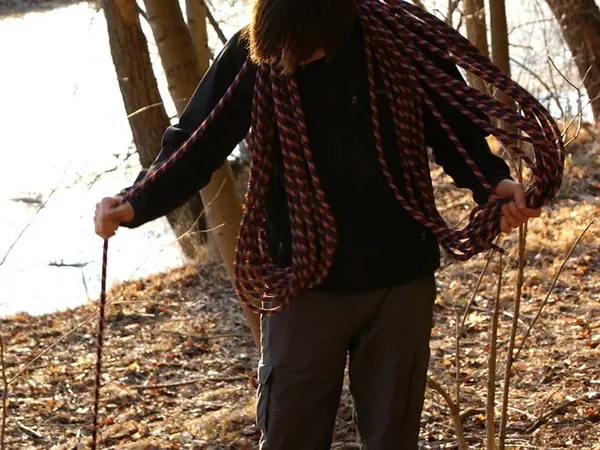
Photo: coiling by michael pollak, CC BY 2.0
A streamlined throw weight that slips through tight spots round bags snag on.
The Weaver bullet throw weight has a narrow, streamlined shape that slips through tight forks and dense twigs where a round bag would hang up. It is a useful second weight for awkward shots.
Round bags are great in open canopy but snag in tight crotches and dense twig growth. A bullet-shaped weight presents a smaller profile, so it slides through gaps and drops back down more cleanly when you work the line toward the union you want.
Throw weights work best with a slick throw line and a cube or bag that lets the line pay out without tangling. Different weights suit different heights and line diameters, so many climbers carry two. See all options in throw weight and line.
It pairs well with a slick throw line, which lets the narrow shape carry full speed through gaps.
Practice pays off with any throw weight. A few minutes of low, controlled shots on an easy tree before the job builds the feel for release point and line management that makes high shots routine.
Check the ring and shell before each use and retire a damaged weight. Because the narrow shape can travel fast, keep the drop zone clear.
Clear the drop zone and call out before every throw. Keep people, vehicles and power lines well clear, and never throw near energized conductors. Once the line is set, pull your climbing line up and inspect the union and the tie-in point before you climb, following ANSI Z133 and the manufacturer's instructions.
| Shape | Bullet |
|---|---|
| Attachment | Ring |
| Brand | Weaver |
Specs are from the manufacturer's published figures where available. Confirm against the product listing before you buy.
In tight forks and dense twigs, where a round bag tends to hang up.
Most climbers carry it alongside a standard round bag for different situations.
Pairs well with
Notch
Pole-mounted slingshot that puts a throw weight into high unions fast.
Gap Arborist Supply
Throw line, weights and storage in one kit for new climbers.
Gap Arborist Supply
Collapsible storage that keeps throw line flaked, clean and tangle-free.
Samson
Slick, thin Dyneema throw line that slides through crotches with little drag.
Teufelberger
Slick, lightweight throw line for setting climbing lines with less snagging.
Teufelberger
A slick, durable throw line built for clean throws and smooth pull-back.
Petzl
A streamlined throw weight that slips through foliage and pulls back clean.
Yale Cordage
Slick, low-stretch throw line for clean, high shots into the canopy.
Weaver Bullet Throw Weight$18