Husqvarna
Husqvarna D-Shaped Carabiner
Auto-locking D-shaped carabiner for arborist climbing kits.
Typical $22
 Auto-Locking Carabiners
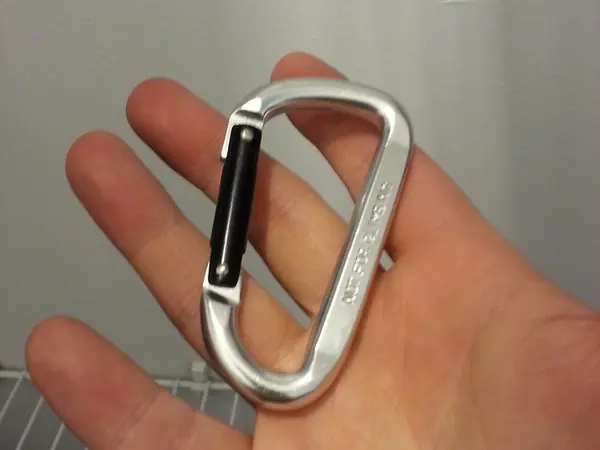
Representative photo. Check the retailer listing for the exact model, color and size.
Photo: carabiner+chains by brenkee, CC0
An oval auto-locking DMM carabiner with a gate built for the US market.
The DMM American O ANSI gate carabiner is an oval auto-locking carabiner made for climbers who need a high-strength gate in their system. Its symmetrical oval shape keeps pulleys, rings and devices centered under load.
Oval carabiners load evenly on both sides, which keeps a micro pulley, ring or device sitting square instead of sliding toward the narrow end as it would in a D. That makes ovals a natural pick for a hitch climber pulley, for clipping a rope wrench, or for anything that needs to stay aligned while it moves.
The ANSI gate designation means DMM built the gate for the higher gate strength required in US standards. Read the ratings on the carabiner itself to confirm it meets the requirement for your use.
Many climbers keep a couple of ovals in their kit specifically for pulleys and rings and use D-shaped biners for the lanyard and bridge, where strength along the spine matters most. Keeping the oval in that role makes it easy to check, and makes sure its strength rating is well suited to the job you are asking of it each day.
Check for rope grooves, sharp edges, cracks and a gate that sticks or does not lock on its own. Retire any carabiner dropped from height onto a hard surface. Compare other auto-locking carabiners for D or offset shapes.
Life-support gear must meet the applicable standard, be used per the manufacturer's instructions and ANSI Z133, be inspected before every climb, and be used only by trained climbers.
| Brand | DMM |
|---|---|
| Shape | Oval |
| Gate | Auto-locking |
Specs are from the manufacturer's published figures where available. Confirm against the product listing before you buy.
It indicates a gate built for the higher gate strength in US ANSI requirements. Confirm with the markings and DMM's instructions.
Ovals often have lower major-axis ratings than D shapes of similar size. Check the markings to make sure it suits your use.
Pairs well with
Husqvarna
Auto-locking D-shaped carabiner for arborist climbing kits.
DMM
A light, auto-locking DMM carabiner with a snag-free nose for everyday climbing.
Petzl
Petzl's asymmetric D locker with a three-action auto-locking gate for climbing systems.
CAMP
A large aluminum oval with a triple-action auto-lock gate for pulleys and devices.
DMM
An aluminum oval with a Locksafe gate and a captive bar to keep devices in place.
ISC
A wide pear-shaped aluminum connector for hitches, anchors and lanyards.
ISC
A symmetrical aluminum oval with a triple-action gate for pulleys and devices.
ISC
A compact oval with ISC's Supersafe auto-locking gate for tight hitch systems.
DMM American O ANSI Gate Carabiner$28