DMM
DMM Captain Hook
A quick-clip accessory hook for keeping tools and gear within reach aloft.
Typical $25
 Other Climbing Gear
Representative photo. Check the retailer listing for the exact model, color and size.
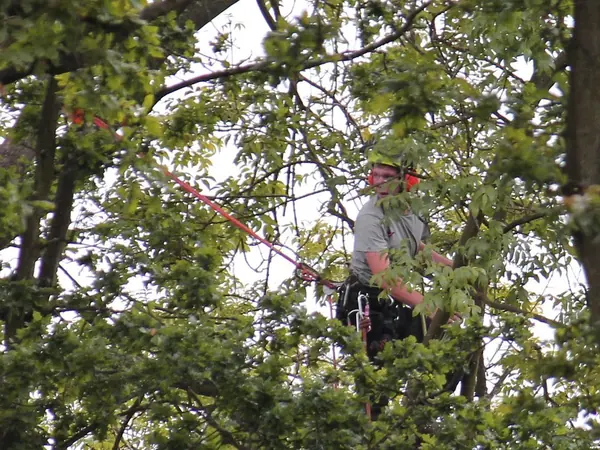
Photo: Tree Pruning in RVA (Carytown, Virginia) by Gamma Man, CC BY 2.0
A textile canopy anchor for setting a secure tie-in point aloft.
Canopy anchors give climbers a secure tie-in point around a stem or limb in the canopy, and this soft canopy anchor does it with textile instead of steel hardware. It is light, wraps around a range of stem sizes and helps protect both the rope and the tree's bark.
Tying in directly around a limb works, but it puts friction on the bark and the rope and does not always give you the best rope angle. Canopy anchors give a clean, consistent anchor point. They spread the load around the stem, protect the tree and reduce rope wear.
A soft canopy anchor uses a textile sling or cord instead of a metal anchor. That makes it lighter and quieter in the kit bag, and it conforms well to irregular stems. Many climbers prefer textile around the tree for that reason.
Canopy anchors are especially common with SRT, where the rope is fixed in the tree and the climber ascends with mechanical devices. A good anchor makes it easier to set a reliable tie-in and to choose the best spot for the work you plan to do.
In single rope technique, the canopy anchor is where your rope is fixed in the tree. In moving-rope systems, it can provide a friction-saving redirect at the tie-in point. The details depend on the anchor's design, your system and the manufacturer's instructions.
Whatever system you use, think about the forces at the anchor. In SRT, the full load goes onto a single anchor point and the limb or stem must be strong enough. Inspect the tree carefully, choose a sound, well-attached stem and avoid dead or weak wood.
If you are setting a canopy anchor for SRT, consider whether the tie-in point allows a good work position for the whole job, or whether you will need to re-anchor partway through. Thinking it through from the ground saves time and reduces unnecessary changeovers aloft.
Look at the anchor's length and how it fits the stem sizes you usually climb on, the hardware it uses, whether it can be set and retrieved from the ground and whether it is rated for life support. Some climbers keep two anchors of different lengths for different trees.
Make sure every connection is compatible: rope, carabiners, rings and the anchor itself. A canopy anchor is only as strong as the weakest link in the system.
Practice setting and retrieving your anchor on the ground before you rely on it in the tree. Know how it should look when properly set, so you can spot a problem from below.
Life-support gear must meet the applicable standards, be used according to the manufacturer's instructions and ANSI Z133, and be inspected before every use. Only trained climbers should use it. Textiles wear faster than metal, so inspect the anchor for cuts, abrasion, glazing, chemical contamination and UV damage before every climb. Retire it if you have any doubt.
Keep textiles away from chainsaw fuel, bar oil and sharp tools. Store them dry and out of sunlight. Browse more climbing gear to complete your kit.
| Type | Textile canopy anchor |
|---|---|
| Use | Tie-in point in the canopy |
| Systems | SRT and moving-rope, per instructions |
| Retrieval | Check the listing for retrievable configuration |
| Rating | See the manufacturer's markings and instructions |
Specs are from the manufacturer's published figures where available. Confirm against the product listing before you buy.
They create a secure tie-in point around a stem or limb in the canopy, protecting the tree and rope and giving a consistent anchor.
It can be when it is rated for life support, used according to the manufacturer's instructions and set on a sound stem. Get training in SRT anchoring first.
Before every climb. Look for cuts, abrasion, glazing, contamination and UV damage, and retire it if in doubt.
Pairs well with
DMM
A quick-clip accessory hook for keeping tools and gear within reach aloft.
SawPod
A purpose-built place to park your saw aloft so it is not swinging off your saddle.
Gap Arborist Supply
Sling and hardware for a releasable base-tied anchor on SRS climbs.
Gap Arborist Supply
Sewn nylon webbing loops for anchors, redirects, and gear organization.
Husqvarna
Helmet muffs with built-in crew talk, so climber and ground can hear each other.
Rock Exotica
A portable load cell for measuring real forces in rigging and climbing systems.
Teufelberger
A ground tarp that keeps your climbing rope out of the dirt at the base of the tree.
Notch
A small grapple for snagging stuck lines and hung gear out of the canopy.
Soft Canopy Anchor$69