DMM
DMM Captain Hook
A quick-clip accessory hook for keeping tools and gear within reach aloft.
Typical $25
 Other Climbing Gear
Representative photo. Check the retailer listing for the exact model, color and size.
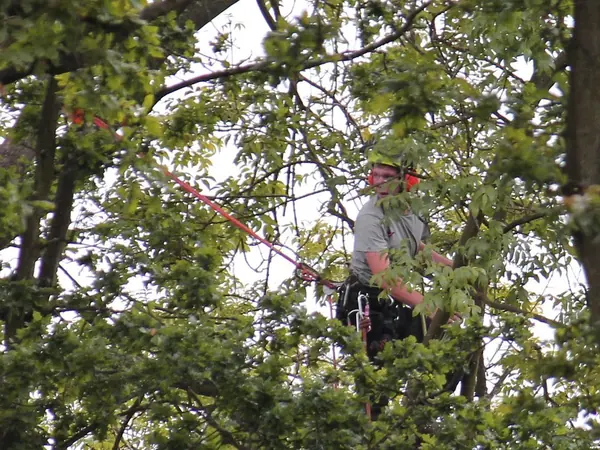
Photo: Caution - Tree Surgeon at work by Clint__Budd, CC BY 2.0
Sewn nylon webbing loops for anchors, redirects, and gear organization.
Nylon loop runners are sewn webbing slings that climbers use to build anchors, set redirects, extend a connection, and organize gear on the saddle. They are light, cheap, and one of the most versatile pieces of soft gear on the harness.
A sewn runner can be girth-hitched or basket-hitched around a limb for a redirect, used to extend a connection past bark, or clipped to a saddle ring to carry tools. Nylon has some stretch and handles knots and hitches well.
Several lengths on the saddle let you adapt to different stem sizes without reaching for rope.
Runners also make simple tool lanyards and gear slings, and a few spares in the kit bag cover a lot of small jobs on the climb.
Webbing is easily cut. Keep runners away from saw chains and sharp edges, and out of sun, chemicals, and fuel. Inspect the stitching and webbing before each use and retire any runner that is cut, faded, stiff, or has damaged stitching. Ratings drop when you tie knots or choke a sling, so follow the marked ratings for each configuration.
Mark each runner with its purchase date and keep track of its age, since webbing loses strength over time even without visible damage. Store runners clean and dry with the rest of your soft gear.
Life-support gear must meet the applicable standard (ANSI Z133 and the manufacturer's instructions), be inspected before every use, and be used only by trained climbers. More climbing gear is here.
| Material | Nylon webbing |
|---|---|
| Construction | Sewn loop |
Specs are from the manufacturer's published figures where available. Confirm against the product listing before you buy.
Nylon is cheaper, stretches a little, and tolerates knots. Dyneema is lighter and stronger for its width but has a lower melting point and is less suited to knots.
Only if the manufacturer approves that use. A purpose-built friction saver is better for a climbing line.
Pairs well with
DMM
A quick-clip accessory hook for keeping tools and gear within reach aloft.
SawPod
A purpose-built place to park your saw aloft so it is not swinging off your saddle.
Gap Arborist Supply
A textile canopy anchor for setting a secure tie-in point aloft.
Gap Arborist Supply
Sling and hardware for a releasable base-tied anchor on SRS climbs.
Husqvarna
Helmet muffs with built-in crew talk, so climber and ground can hear each other.
Rock Exotica
A portable load cell for measuring real forces in rigging and climbing systems.
Teufelberger
A ground tarp that keeps your climbing rope out of the dirt at the base of the tree.
Notch
A small grapple for snagging stuck lines and hung gear out of the canopy.
Nylon Loop Runners$12